Friday, January 30, 2015

Drawing Me In

This is hard.

So, in celebration of that hard, I'm going to make it easy.
Here's a list of ways to draw me into a book.


  1. Have a map- Sounds silly but if I can easily picture where everything is I can be drawn in much easier.
  2. Have a fully threshed out world- I want to see a billion cultures all fully formed and interacting with each other.
  3. Have some interesting character's with interesting relationships- Given. I'm not gonna spend time explaining this.
  4. Keep me guessing- I like to turn the page when I think I know the answer. Makes me really happy if I didn't get it right.
Puzzled male shrugging wearing lab coatThat's pretty much it. Bonus points if its a fantasy world. Copped-out this week.

Wednesday, January 28, 2015

What Draws Me In? A Point of View

What draws you into a story is by and large, extremely personal.  It is probably why we have so many stories out there to choose from and why people use the old adage: there’s something out there for everyone.  That may be true, but at least I can say what draws me into a story.

Let’s ignore picking a story out, since that’s a whole other process to me.  It involves judging a cover, a summery and finally, opening up a random page and checking the style.  In fact, I didn’t read Game of Thrones for years because of these things…which is ridiculous.  I’m a huge Games of Thrones fan.  The books are amazing.  So… ignoring the picking process, let’s delve into what I find interesting enough to keep me coming back to a pages of a book.

The first is writing style, or voice.  I can suffer through ridiculously “Mary-sue” style characters if the voice of the author is engaging.  The language has to compel me to move forward whether through the beauty of the words, the humour, the intensity, or the pacing.  This means that just about any story can engage me if I like the writing style enough.  Case in point: I love Pride and Prejudice, The Parasol Protectorate series, Jurassic Park, and Divergent.  All of these books are vastly different writing styles but the way they string the words along makes me keep turning the pages. 

The second is character.  I’m an actor and I thrive on good characterization.  I gobble it up and beg for me.  It stands to reason that I gravitate toward stories that are character driven.  Does this mean I don’t love a good plot driven tale? No, but what makes me eager to keep picking the book up, is character.  The Blue Girl by Charles de Lint or Libba Bray’s A Great and Terrible Beauty are arguably, character driven books.  Plot will always push those characters forward, but it is the inner push of the character that truly progresses the story. I adore that push.  I want that push.  Give me a character I can walk with, run with, and cry with and I’ll follow them through the fires of a battlefield and back.

The third and final deciding factor is the concept.  I love the extraordinary.  It is why I struggle so much with contemporary fiction and I’m working on that…  but give me time travel, a murder at Pemberley , the fight in the sandy lands of Arrakis, a ghost haunting her friends and trying to save them from her murderer.  I want something that’s unusual and clever.  I want to be taken out of my world and dropped into something else.  I want that little twist and it doesn’t have to be fantasy.  The Fault in Our Stars took us on a journey to meet a horrible man that most would never dream of doing: that’s fantastical.  That’s unusual.  That’s beautiful.

In short, what draws me in is this: I want to hear a voice in the writing.  I want to follow a character through a story.  I want to be taken out of my mundane life.  I just want a point of view.

Friday, January 23, 2015

Fantastical

I lied.

At first I thought the theme of favorite writer would be easy! Duh, clearly Andrew Smith. However, throughout the week as I did research on an upcoming project, I realized that that wasn't true. Andrew Smith has got to be one of the best writers of our generation, hands down. He is, however, not my favorite.

My favorite author almost single-handedly fostered my love in the fantasy genre. His world was so complete and inspired, yet so rooted in our own. His characters have grown up with me and I got to be inspired by their adventures and trials. My favorite author is John Flanagan.

 John's world of Araluen in The Ranger's Apprentice is a magical one that follows the story of Ranger Will as he fights warlords, invaders, slavery, sorcerers, betrayal, and danger. His story is wonderful as we watch him grow into a man and a hero. The dialogue is witty and invented and what every teenager wishes they were smart enough to say.


His most recent series, The Brotherband, chronicles the story of a young man and his crew as they overcome social barriers to change from outcasts to heroes. The Skandians set off on a grand adventure to capture pirates, set off to free slaves, and go to destroy an entire criminal syndicate. They achieve a camaraderie that most people only dream of and reading of their adventures puts you right in the action yourself.


John Flanagan truly opened my eyes to fantasy writing with these tales of Rangers and Skandians, and I highly treasure and recommend them to anyone. Step into this world, and be lost in it for ages.

Wednesday, January 21, 2015

Favorite Author: The Woman Who Shaped Her Genre


Orwell.  Austen. Fitzgerald.  Collins.  Roth.  Bray.  Clare.  When I sat down to try and pin point my favorite author, I ran through the gambit of authors that I loved.  I have so many.  It’s a part of how I read: I read one book from an author and fall in love, and then go out and gobble up every other book from that author.  To say I came back to an author over and over again is hard.  There was a lot of mulling and hard concentration before I realized it: Tamora Pierce is my favorite author.

I found Son of the Lioness and Alanna in middle school.  It was a time in my life where I read only medieval style fantasy and there were her books in the library, all in a row (which as a kid, I loved).  Then I read the back: this girl became a Knight.  No, she wasn’t called a ‘lady,’ but a knight and that was it.  I was sold and blazed through the four book series as if my life depended upon it.  Here was a girl who had to act like a boy, dress like a boy, but still have girl thoughts.  This was a girl I could relate to and for a middle schooling trying to find herself?  It meant the world.


For the next few years, I bounced back and forth between Tortall and the Circle of Magic series.  Every new book that came out, I eagerly waited for.  I wanted to read about these people and I wanted to read about all of these very different girls and how they were still girls but they were powerful.  They were respected.  They were women and more importantly now that I’m more than a decade removed from my first reading: they were written by a woman.  I can’t even begin to express what that means for a girl who would steal away time to scribble words of a story in loose pieces of notebook paper crammed into her planner.  At the time, it wasn’t even a big deal.  Only the mature, older me now knows how important that was for me.

Tamora Pierce’s book kept coming throughout my life.  The Trickster’s Duet has always and will always be my favorite.  Then the Circle of Magic kids got one more tale.  Beka Cooper emerged.  The world kept reviving itself and no matter what part of my life I was at, I turned to these books and I found my home.  They welcomed me with open arms and said:  I am woman and I can do this.  And it wasn’t even about being a woman as we think of it in this modern feminist world, it was about being all of these women.  Alanna was a warrior.  Diane was a beautifully kind soul.  Sandry was a weaver.  Aly was a spy.  Daja was a metal worker.  And there are so many other types of women to love and they are young and passionate and capable of anything.


I never got to thank Tamora Pierce.  I never wrote to her to tell her how her works encouraged me to write about a girl in any circumstance.  I suppose I could do that now, but this is my thank you and it isn’t enough.  My first, fully finished story was a piece of fanfiction set in Tortall.  I wrote my own girl to add to the collection and while I can look back at it and see how very young I was when I wrote it, I am proud.  My first finished story.  She got me writing.  She inspired me.

And now, as I am going through edits so that I can pitch my very own story about a brave, young woman, I can’t help but think: if I hadn’t read Tamora Pierce, would I have written this story?  Would I have written any story?

Thank you, Tamora Pierce.  Thank you.


Visit her website.

Tuesday, January 20, 2015

Why I Adore All Things Andrew Smith

Here's a story.

A few years ago I sat, bored out of my mind, needing to shed like a tortoise his shell the cubicle my mother, brother, and I called our bedroom. I called my brother up. "Yo, bro! Take me to the bookstore."

"Sure thing. Soon as I get home from school," he said.

So we went. I had no idea what I was looking for, just something I'd never read or considered reading before. Thus, I chose The Marbury Lens. Let me tell you, that day I made a choice I did not understand.

All night I flipped page after page after page, wholly fascinated by this kidnapped boy named Jack and all the tap. tap. tap.-ing in his life. The world of Marbury swept me away, this gruesome sub-fantasy that both awes and terrifies. Also, Andrew Smith's inviting prose added an even deeper layer of suspended disbelief.

Beautiful? Yes.

Transcendent? Yes.

Utterly life-altering? Oh yes.

Through my mother, brother and father rousing, dressing, leaving for their day, I read. It wasn't until I looked up at my clock--3:30pm--that I realized, if I didn't hurry, I'd be late for work. Thankfully, I still wore work-appropriate attire from the day before. A quick change of shirt and spread of deodorant stick, and I was out the door, my mind forever blasted by Marbury, Jack, and Andrew Smith. Again, I knew not what choice I'd made. Soon as I got to work (my first ever library job), I sat down at my computer and ILL-ed every single additional Andrew Smith title I could find.

For months, I followed Andrew Smith's self-deprecating blog. And once more, I fell in love, this time with the man himself. He was so reachable, always commenting and responding to comments a core group left on his blog. Part of me kept thinking, Why has no one ever heard of this guy? Why is [insert YA author] popular and this guy isn't? Whatever the answer, I began to revel in the glory and wonder and strangeness that is the world of Andrew Smith.

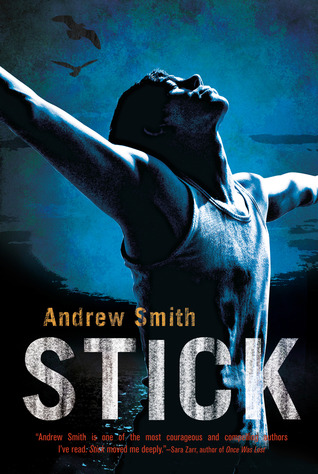
Next was In the Path of Falling Objects--a chilling, haunting read. Then Ghost Medicine--a literary endeavor rife with beautiful language and searing character portrayal. I particularly recall fiending for Stick, and that book shook me to my core. It was the first time I'd realized, amid my battling parents who drove proverbial knives into each other's backs on Christmas Day, that my own mother and father utilized abusive language to keep their children in check, to underpin us, language that, in the end, forces me to this day to question my objectives, question my motives, question the person I'm shaping into. Though I've transmogrified these "questions" into positive thoughts and actions, I could not help but understand my parents in a whole new way. It took me a long time to forgive them after that particular blowup. I shudder to think how I mightn't have noticed their personal demons--reaping their pounds of flesh throughout my bizarre childhood--had I not been reading Andrew Smith's most stirring, beautiful, tender work-to-date. Stick changed my life.

You all probably know Andrew Smith by his latest works, the books that thrust him into the spotlight--deservedly so! Winger and Grasshopper Jungle and 100 Sideways Miles. While I love Winger, I found it more hilarious than moving; I do, however, love and understand everyone's compulsion to weep full-heart at the end. His words are beautiful! I am pumped for Stand-Off, Ryan Dean West's return to YA.

Let me tell you: Grasshopper Jungle destroyed me. In the same way I'd been introduced to Andrew Smith, I now knew him on a whole other level. Not only was this the first time I'd ever--EVER--read a book from the perspective of a bisexual narrator (EVER!), Austin Szerba, while he did not remind me wholly of Jack, his voice recalled classic Andrew Smith. And that's when I knew it, that's when I truly knew why I worshiped this man's stories, this man's words. He's a fucking genius; moreover, we are watching classic literature, books that will be read in classrooms forever like Kerouac or Hemingway or Vonnegut or Lee before him, being written. The gravity of that just bowls me over every time, and that's what reading Grasshopper Jungle felt like.

If A.S. King is the modern Atwood, Andrew Smith wholly embodies Vonnegut. I love his every word, and you should too.


Saturday, January 17, 2015

My Favorite Type of Fiction

FANTASY. Duh.

Fantasy is the reason fiction even exists. Tales of heroes from ancient Greece inspired, and fascinated entire civilizations. The classic story of a knight in armor fighting a Dragon to save a princess is still a very popular image, if not a slightly controversial one.

What we think of fantasy now has actually comes mostly from one culture and one man. The one culture would be the Celts. The Celts with their tales of Faeries, tree spirit elves, and other magical creatures. The man would be Mr. Tolkien, author of The Lord of the Rings. Tolkien took much of his mythology from the Celts and is himself, I believe, a major basis for the fantasy genre in general.

Want to get away? Enjoy a world of Dwarves, Elves, and Dragons? Pick up a fantasy book. You'll surprise yourself.

Thursday, January 15, 2015

Favorite Genre: It's not what you think!

 Rebel Queen by Michelle Moran
Rebel Queen by Michelle Moran

So here’s the thing.  When someone asks me what my favorite genre of fiction, they already have an idea about what I might say.  They tend to think I will answer right away with the dystopian style fiction that has become all the rage (thankfully) in recent years.  On one hand, yes.  They are correct.  I adore it.  I read it constantly and gobble up the latest, eager for another story.  It’s the political scientist in me.  The Orwellian in me.  I will never deny that it is top on my list of genres. 

However…  Yes, I said ‘however.’  It might not be THE favorite genre.  Blasphemy, I know!  Just hear me out.

I went to my bookshelves, and they are scattered about the house in every shelf I can find (arguably, it competes with my movie/tv collection), to take inventory of the type of books I gravitate toward when I troll the local library book sales.  Yes, the dystopian variety is very evident, as is the supernatural (not just vampire) and fantasy.  It’s a lot of YA and you’d definitely know what I like within seconds… but what is less surprising is the overwhelming majority that is the historical fiction book.  Yes, I love historical fiction.

I’m a history nerd, no doubt about that.  I was lucky enough to grow up in a household that let me watch the History Channel and Discovery Channel with abandon.  It fueled my love of what came before us so that we don’t have to make the same mistakes.  It was my favorite class in school.  Most of what I loved about fantasy was the medieval and ancient bits.  You could even make an argument that dystopian literature is historical; it plays with historical ideas and transplants them into a future we don’t know. 

Kleopatra by Karen Essex
But let’s get even more specific: I love historical fiction that focuses on women.  Surprise, surprise.  But here me out here…  We read what we connect with and there is no doubt that I am a woman.  I want to read about experiences that women have had through history to help empower me in this time where I have more legal freedoms than many throughout history.  Just like men and boys like to read about Percy Jackson (I love him too, don’t get me wrong), or Long John Silver (Flint and Silver…read it… it’s fantastic), I like to read about Kleopatra and the Pirate Queen of Ireland.  I’ll even take it with some supernatural or science fiction element.  I really just want to read about the past and connect it to the future.

In historical fiction I can walk with Caesar, fight alongside the Celtic tribes of my ancestors, settle the New World at Jamestown, survive the court intrigues of Revolutionary France, survive the blazing sun with Saladin and conspire with the pirates in Port Royal.  It empowers me to go out and pave a way like they did, even if it is just a small bit of paving.

I love it and I love that it will never go away.

Sunday, January 11, 2015

The Reality of Fiction

One of the things I love most about young adult literature is its unending vastness--authors possess limitless options within the category of YA, and can pretty much write truly wherever the pen leads. While I enjoy the upswell of dystopian literature--The Hunger Games, The Maze Runner, Divergent--and also the wholly-imagined worlds offered by Cassandra Clare, Holly Black, and Sarah Rees Brennan, I must say my heart lies with those stories and authors which relate realism at its core, particularly contemporary realism.

Here's a list (w/cool pictures):
John Green

David Levithan

Carrie Mesrobian

A.S. King

C. Desir

Andrew Smith

Sara Zarr

Steve Brezenoff

John Corey Whaley

Bill Konigsberg

Jim Grimsley (Dream Boy)

Martin Wilson (What They Always Tell Us)

Jason Reynolds

Matt de la Pena

Jacqueline Woodson

Ellen Hopkins

Shaun David Hutchinson 

Laurie Halse Anderson

Chris Crutcher

Lauren Myracle (Shine)

Gayle Forman

Brent Hartinger

Despite the "bounds" of reality, each and every one of these authors has broken severe "rules" of craft, process, and structure of traditional American novel storytelling methods to provide their readers with the most intense, powerful, beautiful, haunting, intelligent, compelling narratives. These authors care about their characters, their words, their readers in a life-altering manner, spinning tales and imagining realities both existing and aspirational. Without them, not only would my stories be destitute, my own writing voice bereft, but also my personal life's journey shrift and malnourished. 

I love what I love. Unapologetically.

YA Matters

In literary circles, we enjoy book discussion. One of the most prevalent notions of said discussions is the "importance" of any particular novel. "Does this book matter?" Or, perhaps more true, "Why does this book matter?" 

Here's the truth: Books matter. To every reader, each book means something specific and individual and personal. To the populace, reading is crucial to life--the benefits are whelming.

So...why YA? Why does young adult literature, written by adults about adolescence--often narrated by adolescents--for adolescents, matter?

1. Every reader requires a mirror.
When we read as children, we read what entertains, whatever interests and fascinates us. As teens, this hardly changes. Only now, as so many of us forget or wish to, that which interests us most is ourselves. This is primal. During our teenage years, we do so much thinking about US because we're trying on the world. We don't know ourselves enough to know where we fit in this vast, sinister, decadent, terrifying world. So we try ourselves on...we sit ourselves down for coffee...we play ourselves music. When, as we read, we witness a fully-realized representation of ourselves in a book, suddenly we know two things: 1) "I exist." 2) "I am not alone."


2. Every reader requires a window.
Seeing US, while important, is not enough. You see, we do not exist in a vacuum, all alone, with no one else to talk to, learn from, live alongside. In order to understand, in order to empathize, in order to love, there must be an entry point into that other person's soul and experience--a window through which we might glimpse. 


3. Every reader requires a sliding glass door.
It is not enough to see into someone else's life, if we are not also willing to act. Books that feature characters whose lives, which differ greatly from our own experience, we can step into, whose shoes we can fill, offer us the chance to act--indeed, to advocate--on another's behalf.


Within YA literature there exists: feminism, gay rights, racial equality, gender fluidity, stories of disabled characters, drug and alcohol-addicted teenagers, abandoned teens, non-nuclear family structures, searing representations of sexual violence narrated by its victims and perpetrators alike. Young adult literature is the literature of our times, of this day and age. YA is the literature of the Millennials.

That's why YA matters.

Wednesday, January 7, 2015

The YA Phenomenon: What is it about YA?

Why write YA (young adult) novels?  The simplest answer I can give is because I read YA novels.  So the next question is inevitably, why read YA novels as a grown woman?  The answer is a complicated one filled with societal woes and a generational gap that is more and more evident than ever.

My generation experienced a hardship that many of the baby boomers can’t really comprehend.  We graduated and became adults in an economic hardship that has made it nearly impossible for us to bounce back… and yes, I could write a huge blog post on this submit but I won’t.  I only mention this because it is what drove us to the exciting happens of the YA atmosphere.

We clung to the dystopian stories, fantastical worlds, contemporary stories of teens overcoming adversaries that were both seen physically and unseen to explain our own feelings of inadequacy (that was constantly shoved in our faces calling us lazy, spoiled, entitled, etc), our feelings of ‘being a caged bird,’ and our feelings on an ever changing society that we were trying to change.  These characters are passionate and have a voice point that I have found lacking in many adult novels.

So maybe it is best to talk about what I don’t like about adult novels to explain what I do like about YA novels.  I don’t like that adult novels feel preachy.  They don’t feel like stories (many historical fiction novels I will exclude on the principle of the subject they are writing on), they feel like lectures.  I think it is wonderful for a story to have a moral lesson, or shine a light on an issue but if that is all your story is doing, then why not lecture on it instead?  Why hide it, poorly I might add, in a fictional story?  I don’t want to be preached at; I want to be entertained.  Now, I will say that not all adult genre writers do this.  I have an equal share of ‘adult’ novels sitting next to my YA, but the tone is so vastly different that it is hard to ignore.

YA novels are writing for an audience that wants to be first and foremost, entertained and connected to.  These characters and these worlds are crafted so that the reader than see themselves or someone they know and feel compelled to keep reading, not to finish the story but because the reader is now invested on an emotional level.

 In short, YA is emotional and our generation is filled to the brim with emotion.  We react with it and are consumed with it and that’s beautiful.  No longer do we hide behind restraint, but we embrace the rollercoaster and so many YA novels are, at their very core, about embracing ‘it.’  That’s their appeal.  That’s their connection to an audience that so many adult novels are lacking in their attempt to up their reading level, tackle ‘adult’ subjects, reveal some great truth.  Great truths are being revealed in YA in a much more accessible way by simply telling the story of a person or group of people with no pretense to show and teach the world something.  By simply telling or ‘showing’ the story, the truth is revealed.

We come back to the question: Why YA?  Because the connection to the audience is like nothing else in this world at this time.  Change and adventure is happening and it’s happening in YA.